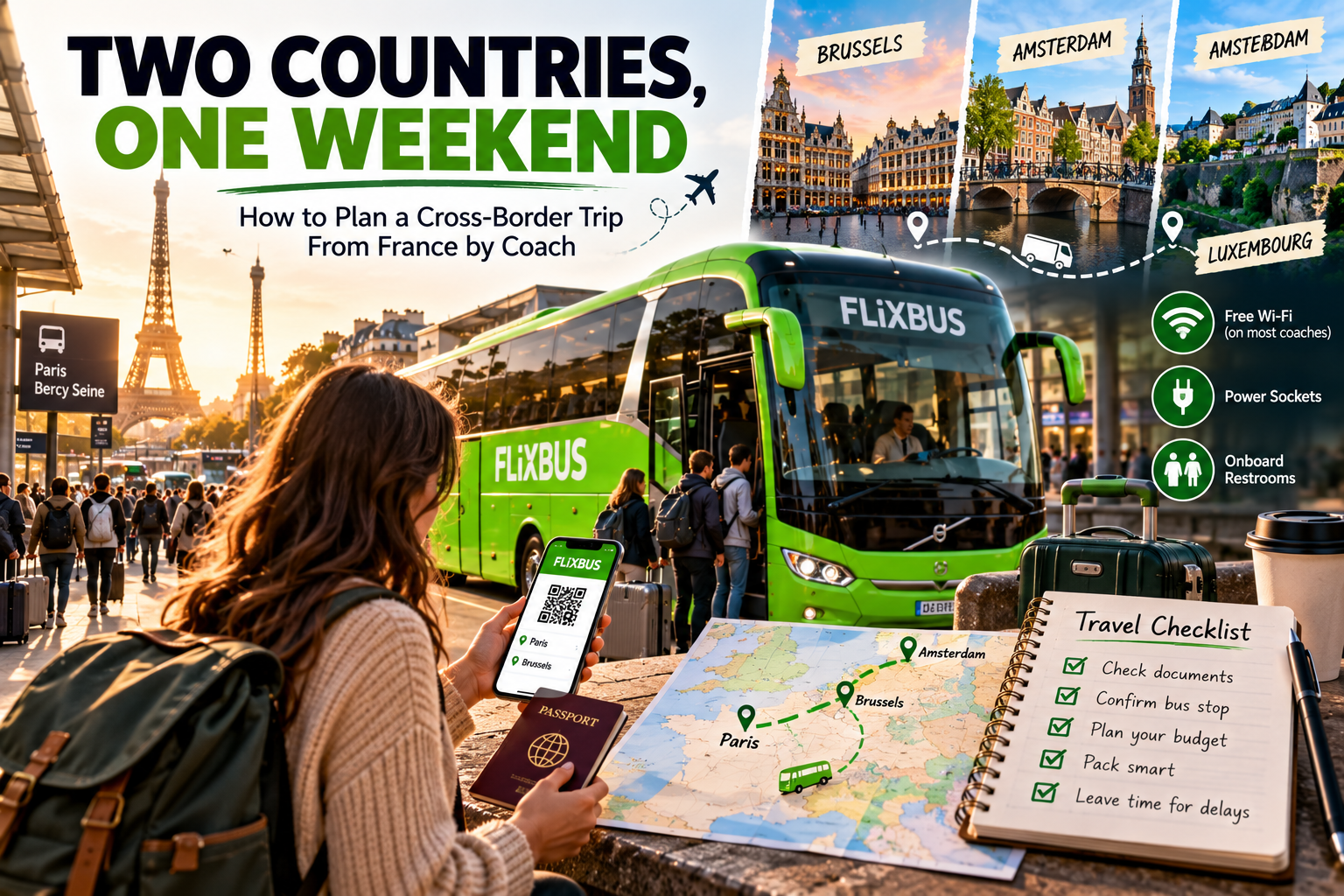
On Friday evening you are in a French city, tired from a long week. By Saturday morning you could be in a different country, with different street signs, a different coffee order and a different skyline outside the window. Coaches have quietly made this kind of trip possible for people who do not want to pay for a flight or plan a complicated rail itinerary. This guide shows how to plan a cross-border trip from France, step by step and in plain words, using FlixBus as the example. We will cover documents, timing, money and safety, along with the limits, so your first border crossing feels exciting instead of stressful.
Why cross-border coach trips are so appealing
Europe is compact, and many major cities are only a few hours apart. A coach can link them without airports, security queues or the need to reach a station far outside town. You can sleep, read, watch a film or simply look out of the window while the landscape changes. For travelers on a budget, it can be a friendly way to see several places in one trip. The trade-off is time, because a coach is slower than a plane or a fast train on many routes. Consider what you value most, then see whether FlixBus fits that plan.
What is FlixBus, in plain words?
It is a European coach network that sells tickets through its website and app. The company’s route pages say you can reach hundreds of destinations from Paris, including cities in Belgium, and they list tickets you can show on your phone, plus free Wi-Fi on most coaches, power sockets and restrooms. Treat this as Unit 1 of your trip planning: know what the service offers before you build an itinerary around it. Facilities, luggage rules and schedules can differ by route and country, so read the details for your exact journey on FlixBus before paying.
Choose a realistic destination
The biggest mistake is choosing a place that is too far for the time you have. Look at the travel time first. A route of three to six hours can work well for a weekend, while a route of ten hours or more eats an entire day each way. Some route pages even list journeys of more than twenty hours for far destinations, which makes sense for a longer holiday but not for a quick escape. Check a map, count your free days and subtract the travel. Then pick a city that gives you at least a full day on the ground. Compare a few options on FlixBus before deciding.
Documents: what to carry
Documents matter more once you cross a border. Always carry a valid passport or national ID card, depending on what the country accepts for your nationality and route. If you need a visa for any country on your trip, arrange it well in advance. Check the official government website for the rules that apply to you, because they change and depend on your passport. Keep your documents in your hand luggage, not in a bag stored under the bus. Treat this as Unit 1 of your border checklist: look up the entry rules before you book. Keep a digital copy of your ticket from FlixBus and your documents in a separate place.
Border checks and extra time
Within parts of Europe, you may cross borders without a formal stop, but checks can still happen, and temporary controls are sometimes introduced. Coaches can be stopped, and officers may ask passengers for identification. Crossing into a country with stricter entry processes can take longer, especially for non-European passport holders or when traveling outside the Schengen area. Do not plan a tight connection right after arrival, and avoid booking a flight or a non-refundable event on the same day. If you are unsure what to expect, read the travel advice on official sites and the journey notes on FlixBus.
Time zones and clocks
Most of western Europe uses nearby time zones, but not all. The United Kingdom, for example, is usually one hour behind France, and some eastern destinations are ahead. That small difference can affect your arrival time, your connection and the check-in time at your accommodation. Make sure your ticket shows local times, and check whether your phone updates automatically. Write the arrival time in the local clock on a note, and tell the person meeting you which time zone you mean. When you review the schedule for a trip on FlixBus, read each departure and arrival time carefully so a clock change does not surprise you.
Money and costs
Different countries may use different currencies, and card fees can add up. Check whether your bank charges extra for foreign payments and whether your card works in small shops and transport machines. Carry a small amount of local cash for emergencies, such as a toilet, a snack or a local bus. Create a daily budget in the new country’s currency, and remember that prices for food and accommodation can differ a lot between cities. Add the cost of your coach ticket, bags and local transport to the total. Compare the full price on FlixBus with the rest of your plan.
Luggage and what you can carry across a border
Luggage rules matter twice on a cross-border trip. First, the coach company sets its own limits for size, weight and number of bags, and the company’s route pages say these are free for one checked bag and one hand bag, with extra luggage for a fee. Second, customs rules cover what you may bring into another country. Treat this as Unit 1 of your packing check: look up limits for food, alcohol, medicine, cash and any restricted items before you go. If you carry prescription medicine, keep it in the original packaging with a note. Read the baggage page on FlixBus and the official customs guidance.
Where you arrive matters
Coach stops abroad can be at central stations, airports or places on the edge of the city. Check exactly where your coach arrives, how far it is from your accommodation and how you will get there. Arriving late at night in an unfamiliar area can be tiring and less safe, so try to choose daytime arrivals when you can. Look at public transport options and approximate costs, and download an offline map. When you pick a route on FlixBus, copy both stop names into your notes.
Planning a multi-city route
If you want to see more than one city, think in a line, not a zigzag. Choose a start, a middle and an end, and make each leg reasonable. Avoid sleeping in a different place every night if your time is short, because packing and traveling every day is exhausting. Leave a buffer between legs in case of delays. Check the opening hours of the places you want to see, and avoid arriving on days when they are closed. Decide which stops are essential and which are optional. Sketch the whole route on paper and then test each leg against the times shown on FlixBus.
Budgeting your time
A cross-border weekend can be shorter than it looks. If your coach leaves on Friday evening and arrives on Saturday morning, you have two days, but you will be tired. If the return leaves on Sunday afternoon, your real sightseeing time is one full day plus a little. That is perfectly fine if you plan for it, and a sign of a good trip if you do not try to see everything. Pick two or three highlights and leave space for wandering. Add rest time and meal time. Compare the schedule on FlixBus with the number of hours you actually have, and be honest about what fits.
Staying connected abroad
Roaming charges and mobile coverage differ by country and provider. Some places within Europe treat roaming as part of your normal plan, while others do not, so check your operator’s rules before leaving. Consider buying a local or international eSIM or SIM if your trip is long. Download offline maps, translations and your tickets before you cross the border, because signal can vanish in remote areas. Keep an offline copy of your booking from FlixBus and your accommodation address, so you are not stuck if your connection drops at the wrong moment.
Safety abroad
Most trips go smoothly, but a few habits protect you. Keep your passport and cards in a secure inner pocket. Be careful with valuables at stations and on crowded transport. Treat this as Unit 1 of your safety routine: know the emergency number and the nearest embassy or consulate. In the European Union, 112 works as a general emergency number, but check the rules for the country you visit. Share your route and arrival time with someone you trust. Avoid accepting offers from strangers who approach you with unusual deals. Keep the contact details of FlixBus and your accommodation on paper as well as on your phone.
When there is a delay
Delays can have bigger consequences when you cross borders. Traffic, weather, border checks or road works can add time to a journey. If your coach is late, check the app, contact support and inform your accommodation or onward connection. Keep your tickets and any messages, because you may need them to ask for assistance. Avoid booking a flight or event the same day you arrive. Do not buy a new ticket in a panic until you understand your options and the terms of your fare. Keep a calm and flexible mindset. Read the terms shown during booking on FlixBus, and write down the support contact before you leave home.
Mistakes to avoid
A few errors repeat. Choosing a destination that is too far for the time. Forgetting to check entry rules and documents. Packing passports in checked luggage. Ignoring time zone differences. Arriving late at night without a plan. Carrying too much, or items that are restricted. Booking a same day flight after arriving by coach. Treat this as a checklist and read it before booking. Whichever company you choose, including FlixBus, a few minutes of preparation before you pay can save a stressful hour at a border or a bus stop.
Questions to ask before you book
Which documents do I need for every country on my route? How long is the journey, and is there a transfer? Where exactly does the coach arrive, and how will I reach my accommodation? What are the luggage limits, and what can I carry across the border? What is the cancellation and rebooking policy for this fare? What happens if the coach is delayed? How will I pay and keep in touch? Write the answers down. If anything is unclear, ask before paying. Clear answers from FlixBus and official sources will make the whole trip feel lighter.
A word of honesty
This post is general information, not travel, immigration or legal advice. Entry rules, customs rules, roaming terms, luggage limits and schedules change and depend on your nationality, route and date, so verify everything with official government sites and with the company before you book. Details here come from the company’s public pages and general knowledge. Delays and cancellations can happen with any operator. And if you decide that FlixBus is not the right fit for a particular trip, that is a sensible outcome of careful comparison.
Final thoughts
A cross-border coach trip does not need to be complicated. Pick a realistic destination, check your documents, leave a buffer, plan your arrival and keep your tickets and contacts organized. Do that, and a Friday evening in France can become a Saturday morning in a completely different place, without any heavy planning. If the schedule and price work for you, open FlixBus, compare the options and book the route that suits your plans. Then pack light, charge your phone and enjoy the feeling of watching the border slip quietly past your window.